
The publication of the Global Risks Report (the Report) is a much-anticipated annual event, and the 2026 edition is now out.
This year it combines the results of the latest Global Risks Perception Survey (the views of over 1,300 global leaders and experts) and in-depth analysis of this survey by 161 experts across the World Economic Forum’s Centres. It’s a goldmine of analysis of potential global risks through three timeframes: 2026, 2028, and 2036.
This blog will focus on the findings relevant to climate change and climate action.
The Report states that “Climate action is caught in societal, political and economic crosswinds”. Let’s see just how turbulent it is.
1. When geo-economic confrontation is top of mind, environmental concerns are de-prioritised
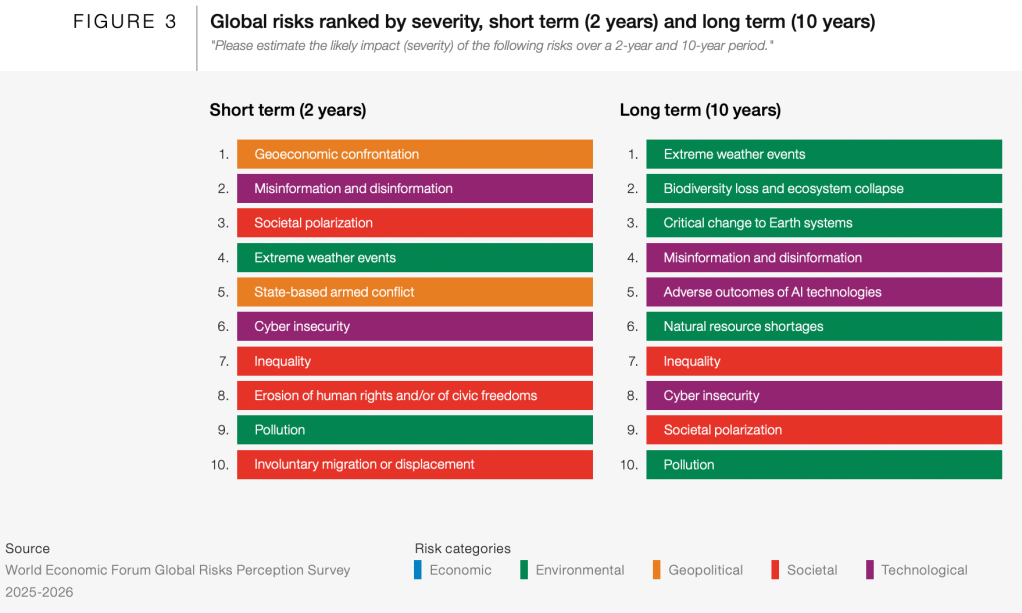
All environmental risks are now ranked significantly lower in the list of short-term priorities than they were last year, and in previous years as well.
‘Geoeconomic confrontation’ is top of mind for respondents and was selected as the top risk most likely to trigger a material global crisis in 2026. It is also the top risk for 2028, up eight positions from last year. This change is understandable as people worry about the lives lost in conflicts, which have sadly dominated the news cycle recently.
People over 40 (and over 50, 60, 70, and 80+) all ranked ‘geoeconomic confrontation’ as the top risk over 2 years, while people under 30 and under 40 ranked misinformation and disinformation as the top risk over the next two years.
Over the short-term, priorities also vary by stakeholder groups and age. Participants from civil society groups ranked ‘extreme weather events’ number 3, while those from the private sector ranked it 6th, and those from government – 7th.
Over the next ten years, however,‘extreme weather events’ take the number one spot for all stakeholder groups, with ‘biodiversity loss or ecosystem collapse’ and ‘critical change to earth systems’ also occupying top spots.
2. Inequality
We know that climate change doesn’t affect us equally, with the poorest countries and the poorest people within all countries being impacted the most.
The report highlights deep funding cuts at many international institutions, which are leading to a retrenchment of development and aid activities – this can also cost lives and livelihoods.
While economic risks have some of the sharpest rises in ranking compared with last year, there is again a difference between how age groups perceive them. People under 30 put ‘lack of economic opportunity or unemployment’ as their 4th top risk over 2 years, while the only other group that has included it at all in their top ten is people over the age of 70, and they ranked it 10th.
Increased inequality is rightly identified as a serious issue by the survey participants. The UN Secretary-General António Guterres in his recent address to the UN General Assembly said that the richest 1% now control 43% of global financial assets – he described this state of affairs as morally indefensible and politically dangerous.[1]
3. Physical critical infrastructure vs AI
The report highlighted that critical infrastructure (such as transport networks, power grids and water systems), across the world is becoming increasingly vulnerable to both chronic climate risks, such as sea-level rises, and acute extreme weather events, including extreme heat, forest fires, floods and storms. It will require costly maintenance and upgrading over the coming years and decades – something that many countries are perhaps not entirely ready for.
“Moreover, when critical infrastructure failures do occur, vulnerable populations are often the hardest hit, contributing further to already-high inequality and societal polarisation.”
Updating and improving critical infrastructure is undoubtably expensive, but it provides opportunities to advance low-carbon, energy efficient, and weather-resistant innovation, for the benefit of all citizens.
There appear to be no delays in building the AI infrastructure and the global market size for AI is projected to rise from an estimated $280 billion in 2024 to $3.5 trillion by 2033.
The Report states that AI-related infrastructure can result in degraded air quality and pollution from manufacturing, electricity generation and e-waste disposal, and as generative AI models can consume up to 4,600 times more energy than traditional software, its climate impacts are already, in one word, enormous.
The chapter on AI in this Report is informative and worryingly points out that the rising range of military use cases for AI, which in the worst case can lead to rapid and perhaps unintentional escalation of conflicts, thereby exacerbating ‘Geoeconomic confrontation’ risk which ranked number one this year.
Another useful resource that came out around the same time is Katherine Hayhoe’s newsletter on the topic of “When AI hurts the climate – and when it helps,” [2] which describes many potential benefits AI can have on climate, such as analysing huge datasets to predict extreme weather occurrences and to accelerate the low carbon transition.
4. Misinformation
Although we are increasingly aware of the risks of misinformation, this report shows that many of us lack confidence in our abilities to identify when content is manipulated.[3]
The links between misinformation, particularly around denying climate science and the delayed climate action are obvious, but the report points out another relevant issue – how content we view on social media makes us more emotionally and cognitively detached and numbed to human tragedies. What happens to our empathy when we are used to seeing images that are later proven false? Climate action requires human compassion, and we can’t afford to let it wither now.
5. A perceived vacuum in global governance is bad news for climate action
The Global Tipping Points Report 2025 warns that the potential for multilateral cooperation on environmental concerns is being weakened, as major powers prioritise sovereignty and national gain over collective action.[4]
Saadia Zahidi said: “rules and institutions that have long underpinned stability are increasingly deadlocked or ineffective in managing this turbulence” and
“.. collaborative approaches remain essential to sustain economic growth, accelerate innovation responsibly, and build adaptive capacity for an increasingly complex era.”
Conclusion
As people focus more on ‘Geoeconomic confrontation’ or economic issues they might not put climate action front of mind. Many people commenting on this year’s Global Risks Report have described it as altogether bad news for climate action.
However, it is not entirely bad news in my opinion. The increased focus on other issues can still benefit climate action, as it is inevitably interconnected with all the other risks and opportunities.
If addressing confrontation and working towards peace were successful, it would allow more people to focus on the environment around them, instead of daily worries about survival.
Fighting inequality is in itself a climate action, as progress there would allow more people to weather climate impacts better.
Updating physical infrastructure is a climate action when it’s making essential systems more energy efficient and more resilient.
AI, while causing initial environmental damage, can be used for climate action, as it increases capacity to analyse scientific data and find efficiencies in hard to abate technologies. There are many risks there, that should not be overlooked, but many opportunities as well.
Tackling misinformation can be a form of climate action, as lies and deceit around climate hurt our hard-won progress.
The report is clear that: “The future is not a single, fixed path but a range of possible trajectories, each dependent on the decisions we make today as a global community.”
The more work we do to address all of the risks mentioned above, the better chance we have of walking a safer and greener path to the future.
You can read the report in full here.
[1] https://onestopesg.com/esg-news/un-chief-warns-of-a-world-in-chaos-as-impunity-and-unpredictability-spread-1768546987663?utm_source=brevo&utm_campaign=OneStop%20ESG%20Newsletter%2082&utm_medium=email&utm_id=221
[2] https://mailchi.mp/754e1a883f1b/talking-climate-now-in-your-inbox-10354910?e=8ab048f701
[3] Dennehy, Fiona (2024, July 2). 9 in 10 concerned about deepfakes affecting election results. The Alan Turing Institute. https://www.turing.ac.uk/news/9-10-concerned-about-deepfakes-affecting-election-results
[4] Global Tipping Points. (2025). Global Tipping Points – understanding risks & their potential impact. https://global-tippingpoints.org/
 Private Goodness